

The Foundation Every Website Needs
Every successful SEO strategy begins long before keywords, backlinks, or content calendars. It starts with one essential requirement: a technically solid, fast, and properly structured website. Without this foundation, even the best content cannot reach its full potential in search rankings.
This first part of our SEO webinar series explores the technical essentials every website needs to address.
Why technical SEO comes first
Search engines reward websites that are fast, stable, and easy to understand. If your site loads slowly, has structural issues, or lacks critical metadata, search engines will struggle to index it properly, and users will leave before engaging.
A proper technical foundation ensures that all future SEO work is amplified instead of wasted.
Performance optimisation
Speed is one of the strongest signals for both user satisfaction and search engine ranking. A slow website loses visitors, conversions, and trust.
To improve performance, you should optimise all images and use the correct dimensions. Use modern formats such as WebP or AVIF and make sure to minify JavaScript and CSS. Enable gzip or brotli compression, lazy-load heavier components, and delay non-essential resources. Reducing unused scripts and blocking elements will also make a significant difference.
To measure how well your site is doing, use Google PageSpeed Insights. It doesn't just measure speed. It also evaluates accessibility, best practices, and SEO fundamentals. Since Google operates the world's largest search engine, their scoring tool should be one of your primary technical references.
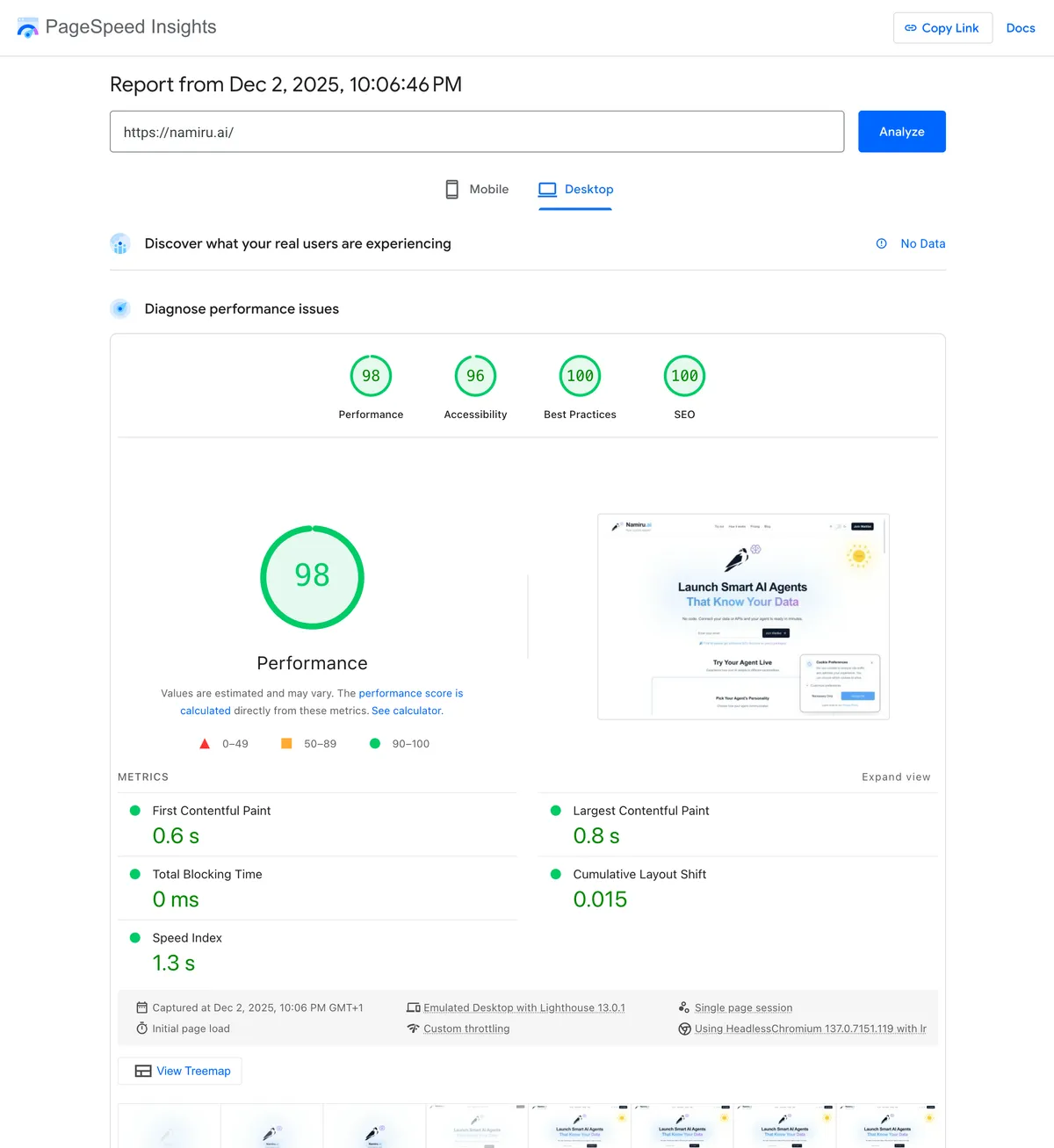
Ours? Sorted. How's yours? Test it here Google PageSpeed Insights
Clean, accessible, and error-free code
Strong SEO starts with strong code. Search engines and users alike depend on a well-organised structure to navigate and understand your site.
Use semantic HTML by choosing the right elements for the right purpose. This helps crawlers interpret your content correctly. Accessibility is equally important: proper ARIA attributes, sufficient colour contrast, and alt attributes for images aren't just nice-to-haves. They directly impact how search engines evaluate and rank your site.
Keep your console free of runtime errors and warnings, as these can signal poor code quality to both developers and crawlers. And your site must be fully responsive and mobile-friendly. With mobile-first indexing now the standard, this is non-negotiable.
Core SEO essentials
Even a fast, well-built website will struggle in search rankings if it lacks the metadata that helps search engines understand and index your content properly.
First, make sure your pages are actually discoverable. Check that indexing isn't blocked, your robots.txt is valid, and you have a correct sitemap submitted to search engines. This is how crawlers efficiently find all your pages.
Every page needs proper on-page metadata: a clear title tag, a compelling meta description, and a valid HTTP status code. For content management, include a rel=canonical link to prevent duplicate content issues, and if you're running a multilingual site, set up valid hreflang links.
Finally, pay attention to your link structure. All links should use descriptive anchor text that tells both users and search engines what to expect, and they must be crawlable. JavaScript-rendered links that search engines can't follow will hurt your discoverability.

Server-side rendering for better SEO
For optimal performance and crawlability, your application should ideally be server-side rendered (SSR). Delivering pre-rendered HTML improves indexing and boosts first contentful paint times, making your site feel faster and more reliable.
Here's something many developers don't realise: popular frameworks such as Angular, React, and Vue are fully client-side rendered by default. This means the browser receives an empty HTML shell, and JavaScript builds the page content after loading. The problem? Search engine crawlers may not wait for or execute that JavaScript properly, which means your content might never be indexed.
If you're using these frameworks and SEO matters to you, look into their SSR solutions: Next.js for React, Nuxt for Vue, and Angular Universal for Angular. Without proper server-side rendering, even a beautifully built application can be nearly invisible to search engines.
A complete blog comparing client-side and server-side rendering will be released soon, explaining when each approach is beneficial and how they impact SEO.
Conclusion
Real SEO begins with strong technical fundamentals. Make your website fast, accessible, correctly structured, and search-friendly, and everything else you build on top of it will perform better.
This is the foundation. Once it's solid, you're ready for what comes next.
This is Series #1: SEO from a Technical Perspective - The Must.
We're just getting started. Stay tuned for the next parts of this series.